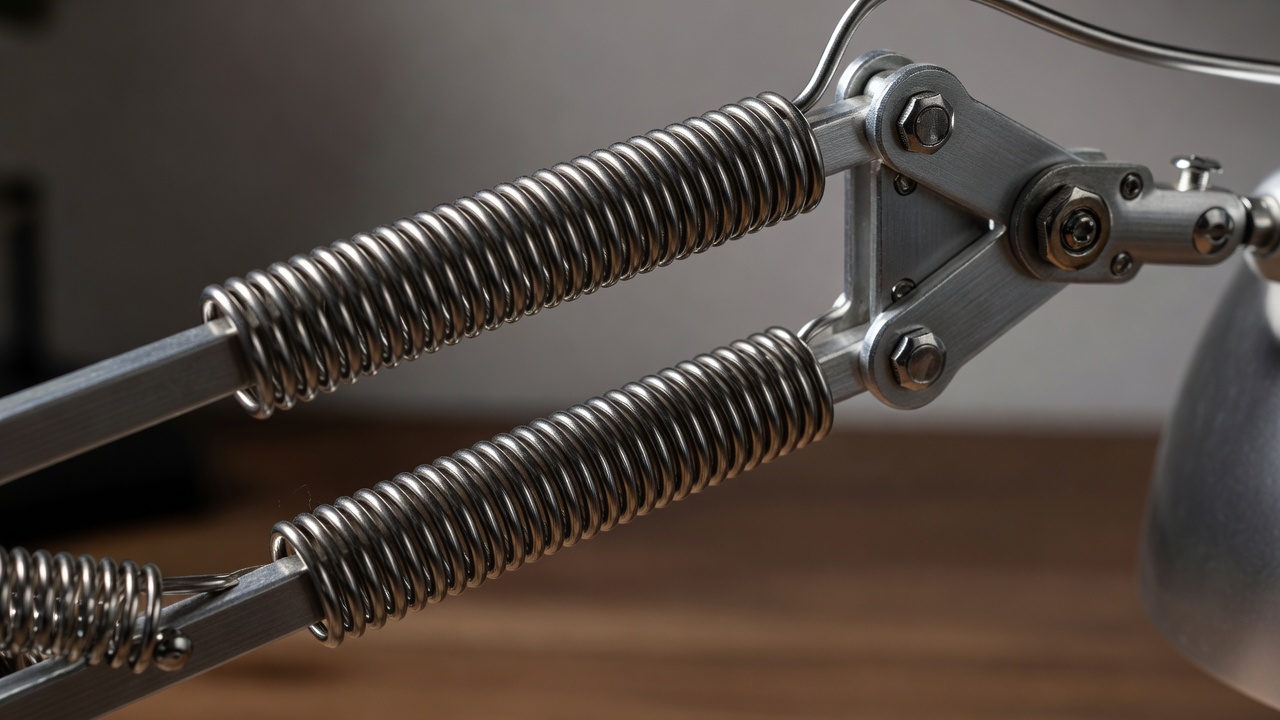
A Revolution in Tension
The defining characteristic of an architect lamp—often referred to interchangeably as a drafting lamp or balanced-arm lamp—is its ingenious mechanism of constant-tension springs. Originally adapted from vehicle suspension concepts in the 1930s, this design allows the user to reposition the light source with minimal effort. The moment you release the lamp head, it stays exactly where you left it, defying gravity through perfectly calibrated mechanical equilibrium.
This effortless adjustability made it an instant necessity for architects, draftsmen, and engineers who worked on expansive, angled drawing boards. Because drafting requires meticulous attention to detail over large areas of paper, a static light source simply would not suffice. The ability to pull the lamp down close for fine detail work, and push it away for an overview, completely changed the ergonomics of desk work.
Key Design Components
When evaluating an architect lamp for a modern workspace, several core components dictate both the aesthetic appeal and structural longevity of the piece:
- The Articulated Arm: Usually consisting of two main segments joined by a central elbow, the arm provides the extensive reach characteristic of these lamps. Higher-end models utilize aerospace-grade aluminum or solid steel, whereas budget variants may rely on hollow, thin-gauge tubing that can warp over time.
- Tension Springs: These are the heart of the lamp. Quality springs maintain their tension over decades of use. If the springs are too weak, the lamp head will sag; if they are too strong, the lamp will spring back when pulled down.
- The Shade: Typically a spun metal bell or cone, the shade is designed to direct light downward in a concentrated pool while shielding the user's eyes from the bare bulb. Many shades feature a vented top to allow heat from traditional incandescent bulbs to escape, preventing the metal from becoming dangerously hot to the touch.
Mounting Options
Because architect lamps are designed to extend far across a workspace, their center of gravity shifts dramatically during use. To counter this, they require robust mounting solutions.
The most traditional mount is the heavy, weighted desk base. These bases must be exceptionally heavy—often made of cast iron or weighted with sand—to prevent the lamp from tipping when the arm is fully extended. While stable, these bases consume valuable desk real estate.
Alternatively, the C-clamp mount is incredibly popular for architect lamps. By securing the base of the lamp directly to the edge of the desk, the footprint is reduced to nearly zero. This is particularly advantageous for small desks or craft tables where every square inch matters. The clamp also provides absolute stability, allowing for aggressive repositioning without fear of the lamp toppling.
Modern Adaptations and Bulb Compatibility
While the mechanical design of the architect lamp has remained largely unchanged for nearly a century, the technology powering the illumination has evolved. Traditional models featured standard E26 or E27 screw sockets, intended for incandescent bulbs. Today, these sockets are typically populated with LED retrofit bulbs.
Choosing the right LED bulb for a vintage or traditional-style architect lamp is crucial. Because the shade acts as a directional reflector, a bulb with a wide beam angle is preferable to ensure an even pool of light. Additionally, selecting a bulb with a high Color Rendering Index (CRI of 90 or above) ensures that colors appear accurate—a critical requirement for artists, designers, and hobbyists.
Pros and Cons
Advantages
- Unmatched adjustability and reach across large workspaces.
- Timeless, industrial aesthetic that suits various decors.
- Highly durable mechanical components that can last lifetimes.
- Standard sockets allow for easy bulb replacement and customization.
Considerations
- Exposed springs can occasionally catch dust or cables.
- Weighted bases are very heavy and take up desk space.
- Requires regular manual adjustment; no automated lighting features.
- Cheaper models often suffer from sagging joints over time.
Is an Architect Lamp Right for You?
If your work involves moving around a desk, referencing multiple documents, drawing, drafting, or crafting, the architect lamp is an unparalleled tool. Its ability to deliver high-quality task lighting exactly where it is needed, on demand, makes it a functional powerhouse. For those who appreciate mechanical ingenuity and industrial aesthetics, the architect lamp serves not just as a light source, but as an inspiring piece of workspace architecture.