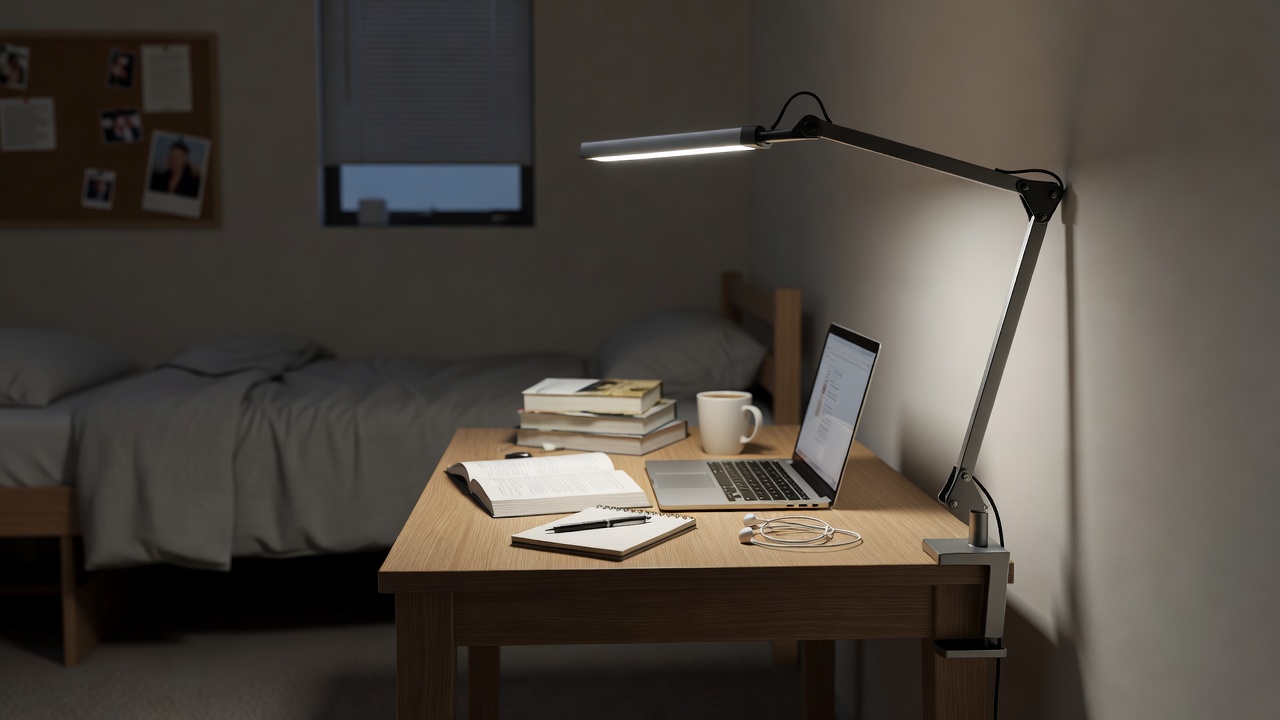
The Zero-Footprint Advantage
The modern workspace is increasingly crowded. Between dual monitors, mechanical keyboards, ergonomic mice, and reference materials, finding space for a heavy lamp base can feel impossible. Clamp and clip-on lamps bypass this problem entirely by anchoring to the vertical edges of your environment.
By suspending the light source from the perimeter of the desk, a shelf, or a monitor riser, these lamps provide overhead and directional task lighting without interfering with your physical workflow. This makes them exceptionally popular in dorm rooms, tiny home offices, and dedicated crafting or sewing tables where every inch of flat surface is required for the task at hand.
Types of Mounts: C-Clamp vs. Spring Clip
While often grouped together, clamp lamps generally utilize one of two distinct mounting mechanisms, each suited for different environments:
- The C-Clamp (or Screw Clamp): This mount functions similarly to a vise. You slide the bracket over the edge of a desk and tighten a threaded screw until it is firmly locked in place. C-clamps are incredibly secure and can support heavy, articulated lamp arms (such as large architect lamps) without risk of slipping. They do, however, require a desk with an overhanging lip; they cannot mount to desks with flush modesty panels.
- The Spring Clip: Operating like a large clothespin, the spring clip relies on mechanical tension to grip a surface. These are much faster to reposition than C-clamps, making them ideal for users who move their light source between a desk, a bed headboard, and a reading chair. However, spring clips generally support lighter, smaller lamp heads (like lightweight LED goosenecks) and can slip if bumped aggressively.
Protecting Your Furniture
A common concern with clamp lamps is the potential for damage to expensive wooden desks or fragile glass surfaces. High-quality clamps address this by featuring thick rubber or silicone padding on both the top and bottom contact points. When installing a C-clamp, it is crucial not to over-tighten the screw, as excessive pressure can warp composite woods or shatter tempered glass over time.
Flexibility and Articulation
Because clamp lamps are anchored firmly to the periphery of the desk, they rely on flexible arms to bring light to the center of the workspace. This articulation usually takes one of two forms:
The Gooseneck: A flexible metal tube that can be bent, twisted, and curled into virtually any position. Goosenecks are fantastic for micro-adjustments and feature a smooth, organic aesthetic. However, very cheap goosenecks may slowly droop under the weight of the lamp head over time.
The Articulated Arm: Similar to an architect lamp, these feature rigid segments joined by tension-supported hinges. They offer a much longer reach than goosenecks and maintain their position with mechanical precision, though their movement is restricted to specific axes.
Pros and Cons
Pros
- Frees up 100% of the desk space traditionally taken by a lamp base.
- Highly secure mounting prevents accidental tipping.
- Can be attached to unconventional surfaces (shelves, bed frames).
- Often highly adjustable via goosenecks or jointed arms.
Cons
- Requires a desk or surface with a sufficient overhanging lip.
- Not easily portable once a screw-clamp is tightly installed.
- Cables hang down off the edge of the desk, requiring cable management.